
HTTPS
HTTPS
HTTPS enables encrypted web-based communication between Wise SCADA and clients. When HTTPS is used, SCADA screens, web pages, and HTTP-based services can be accessed over a secure connection.
To use an HTTPS connection, an appropriate certificate must be created for the IP addresses or host names that will be used to access the system.
HTTPS Certificate Management
HTTPS Certificate Management allows you to create and manage the certificate used by the Web Server and HTTPS-based connections.
To access this window, go to the Setup section and click the Open button in the HTTPS Certificate Management row.
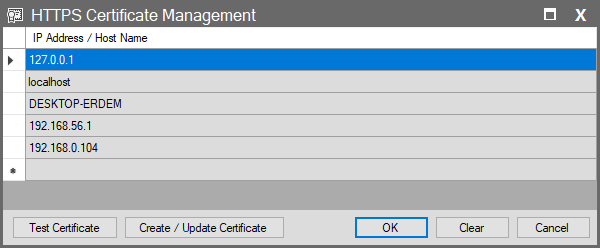
In the window that opens, define the IP Address / Host Name information for which the certificate will be valid. IP addresses and host names that may be used to access the SCADA system over HTTPS can be added to this list.
For access from the same computer, 127.0.0.1 or localhost can be used. For access using the computer name, enter the corresponding host name. For access from other devices on the network, use the appropriate IP address of the SCADA computer.
Note: It is recommended to add all required IP addresses and host names to the certificate based on the addresses users will use to connect to the SCADA system.
- Test Certificate : Checks whether the existing certificate can be used for HTTPS connections.
- Create / Update Certificate : Creates an HTTPS certificate or updates the existing certificate based on the IP addresses and host names defined in the list. If the IP address or host name list is changed, the certificate may need to be updated again.
- Clear : Clears the defined IP address and host name list.
Certificate Creation
After defining the IP addresses and host names, create the certificate using the Create / Update Certificate button.
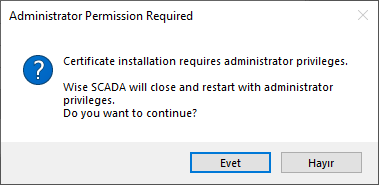
Creating and installing the certificate on the system requires administrator privileges. When necessary, Wise SCADA informs the user and asks for the application to be restarted with administrator privileges.
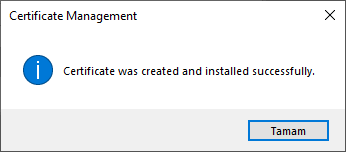
When the operation is completed successfully, the following message is displayed:
When the certificate is created, a Certificate folder is created inside the project folder.
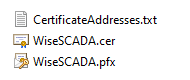
- CertificateAddresses.txt contains the IP addresses and host names used when creating the certificate.
- WiseSCADA.cer is the public certificate file that can be installed on client computers.
- WiseSCADA.pfx contains the certificate and private key information that can be used by HTTPS services.
Note
- WiseSCADA.pfx may contain private key information, it should not be distributed to client computers. Use WiseSCADA.cer for client installation.
- Moving the project folder to a different location on the same computer does not affect the certificate. However, if the IP address or host name used for the HTTPS connection changes, the certificate may need to be updated.
Certificate Installation
To securely access the HTTPS connection from another computer, the WiseSCADA.cer file must be installed on the computer that will act as the client.
The installation is performed through Windows:
- Double-click the WiseSCADA.cer file.
- Click Install Certificate.
- Select Local Machine.
- Approve the administrator permission request.
- Select Place all certificates in the following store.
- Click Browse.
- Select the Trusted Root Certification Authorities store.
- Complete the installation by following Next → Finish → Yes.
- Close all Chrome or Edge windows and reopen the browser.
After the installation is completed, the client computer recognizes the generated certificate as trusted, and the HTTPS connection can be used securely.
For example, if the following address will be used:
https://192.168.0.104
the IP address 192.168.0.104 must have been included when the certificate was created.
Difference Between Server and Client
- The computer where the certificate is created and the HTTPS service is running can be considered the Server, while the computer accessing SCADA over HTTPS can be considered the Client.
- On the Server computer, the certificate is created using HTTPS Certificate Management.
- On the Client computer, the WiseSCADA.cer file generated by the Server is installed in the Trusted Root Certification Authorities store.
- Therefore, if HTTPS connections will be made from multiple computers, the certificate may need to be installed separately on each client computer.
Difference Between HTTP and HTTPS
- With HTTP communication, data between the client and SCADA is transmitted over a standard HTTP connection.
- With HTTPS, the connection is protected using TLS.
|
Feature |
HTTP |
HTTPS |
|
Connection |
Unencrypted |
Encrypted |
|
Default Port |
80 |
443 |
|
URL |
http:// |
https:// |
|
Certificate |
Not Required |
Required |
HTTPS is especially recommended when the SCADA system will be accessed from outside the local network or when sensitive information, such as user login credentials, is transmitted.